

Gaza Tragedy: Another Palestinian Baby Dies of Cold

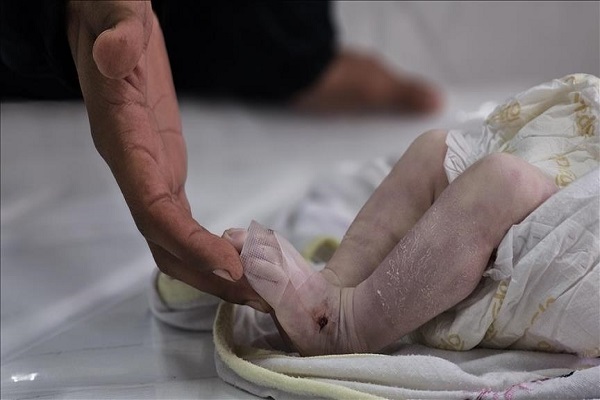
It comes as the Israeli regime continues its blockade and military attacks more than three months after a ceasefire was announced.
According to Gaza’s Health Ministry, the baby died overnight from severe cold, bringing the number of children who have died from winter exposure since the start of the season to 10.
The ministry said the deaths come as displaced families across the Gaza Strip remain without shelter amid harsh weather and storms, while the Israeli regime continues repeated violations of the ceasefire through ongoing attacks and killings.
The ministry reported continued bombardment by the army of the occupying Israeli regime in several areas of Gaza.
It said a number of civilians were killed and wounded in strikes in both northern and southern parts of the enclave.
According to the ministry, at least 477 Palestinians have been killed and more than 1,300 wounded in attacks by Israeli forces since the ceasefire took effect.
Separately, the UN Office of the High Commissioner for Human Rights in the Occupied Palestinian Territory warned of the continued killing of civilians by the Israeli regime in Gaza as part of broader patterns of violence.
Turning to the humanitarian impact, the United Nations Relief and Works Agency for Palestine Refugees (UNRWA) warned of the collapse of educational services in Gaza.
UNRWA said around 600,000 children have been deprived of education, after the Israeli regime destroyed civilian infrastructure, including schools, a genocidal war on the enclave.
The agency said many students and education workers have been killed, while schools have been systematically damaged or destroyed.
UNRWA Commissioner-General Philippe Lazzarini said more than 600,000 children in Gaza have been denied formal education for more than two years.
“More than 600,000 children in Gaza have been deprived of formal education for over two years, and these children are experiencing very deep trauma amid the rubble,” Lazzarini said.
He said restoring access to safe learning environments was a top priority for UNRWA.
Lazzarini added that around 65,000 children are currently attending temporary learning spaces run by the agency in Gaza.
Read More:
He said nearly 300,000 more children are receiving basic literacy and numeracy education through digital platforms.
According to data published by UN-affiliated bodies including UNESCO, UNRWA and the UN Office for the Coordination of Humanitarian Affairs, about 745,000 students in Gaza have been deprived of formal education since the war began on Oct. 7, 2023, for a third consecutive year.
The figures include 88,000 university students whose education has been completely halted, a situation UN agencies described as a dangerous precedent that risks denying an entire generation access to learning.
Documented UN reports show that between 95% and 97% of schools and educational facilities in Gaza have been damaged.
These include public schools, UNRWA-run schools and private educational institutions.
Many of the facilities have been completely destroyed, while hundreds of others are unusable and require extensive repair and reconstruction.
Education specialists say the prolonged disruption, combined with the destruction of schools, restrictions on UNRWA’s work and limits on student movement, has caused unprecedented educational losses.
They estimate the damage is equivalent to three to five years of formal education, with long-term catastrophic consequences for human development and socio-economic stability in Gaza.
UNICEF has also warned of the risk of losing an entire generation of children in Gaza and of a total collapse of the education system.
After a visit to the Palestinian territories, UNICEF’s Middle East and North Africa regional director, Edouard Beigbeder, told Agence France-Presse: “This is the third year without school for Gaza’s children, and if we cannot create conditions for their return to schools by next February, we will enter a fourth year without schooling, after which we can speak of a lost Palestinian generation.”
He said that following the start of the ceasefire on Oct. 10, 2025, UNICEF and its education partners managed to bring about one-sixth of school-age children back into temporary learning spaces.
However, he said 85% of Gaza’s schools have been destroyed or rendered unusable, while many of the remaining schools are being used as shelters for displaced families.
Beigbeder said educational conditions had already been dire even before the war.
He said temporary learning centers are set up in schools, near displacement camps or inside tents, with wooden boxes used as desks.
“I have never seen teachers and students able to sit comfortably, and many children sit on cold ground,” he said.
He said education is essential to restoring social cohesion among children, nearly all of whom suffer from psychological trauma and require support.
“One of our top priorities right now is allowing in construction materials to build temporary schools, as well as educational supplies, which Israel does not allow to enter,” he said.
“How can we really build classrooms without construction materials?” he added.
He said students in Gaza are also deprived of the most basic school supplies such as books and notebooks.
While access to food and water has become the most urgent concern for Gaza’s population, he said education must not be forgotten amid what he described as a catastrophic humanitarian crisis.
Source: Agencies
